
Sinocare Presents USA Multi-Centre Pediatric Data for the iCan CGM System at EASD 2026
Sinocare presented new clinical data highlighting that the iCan continuous glucose monitoring (CGM) system maintained single-digit accuracy in children and adolescents with type 1 diabetes across the full 15-day wear period, at both the abdomen and the upper arm wear sites. The findings were delivered in a short oral session at the 62nd Annual Meeting of the European Association for the Study of Diabetes (EASD 2026), held from September 28 to October 2, and were also presented as ePoster 977.
In participants aged 7–17 years, the factory-calibrated sensor achieved an overall mean absolute relative difference (MARD) of 8.5% when sited on the abdomen (ABD) and 8.6% on the upper arm (Arm), measured against venous reference. More than 99.9% of paired readings fell within Zones A and B of the Parkes Error Grid, and 93.8% of abdominal and 93.5% of Arm readings agreed within 20/20%. No device-related serious adverse events were reported in this pediatric study.
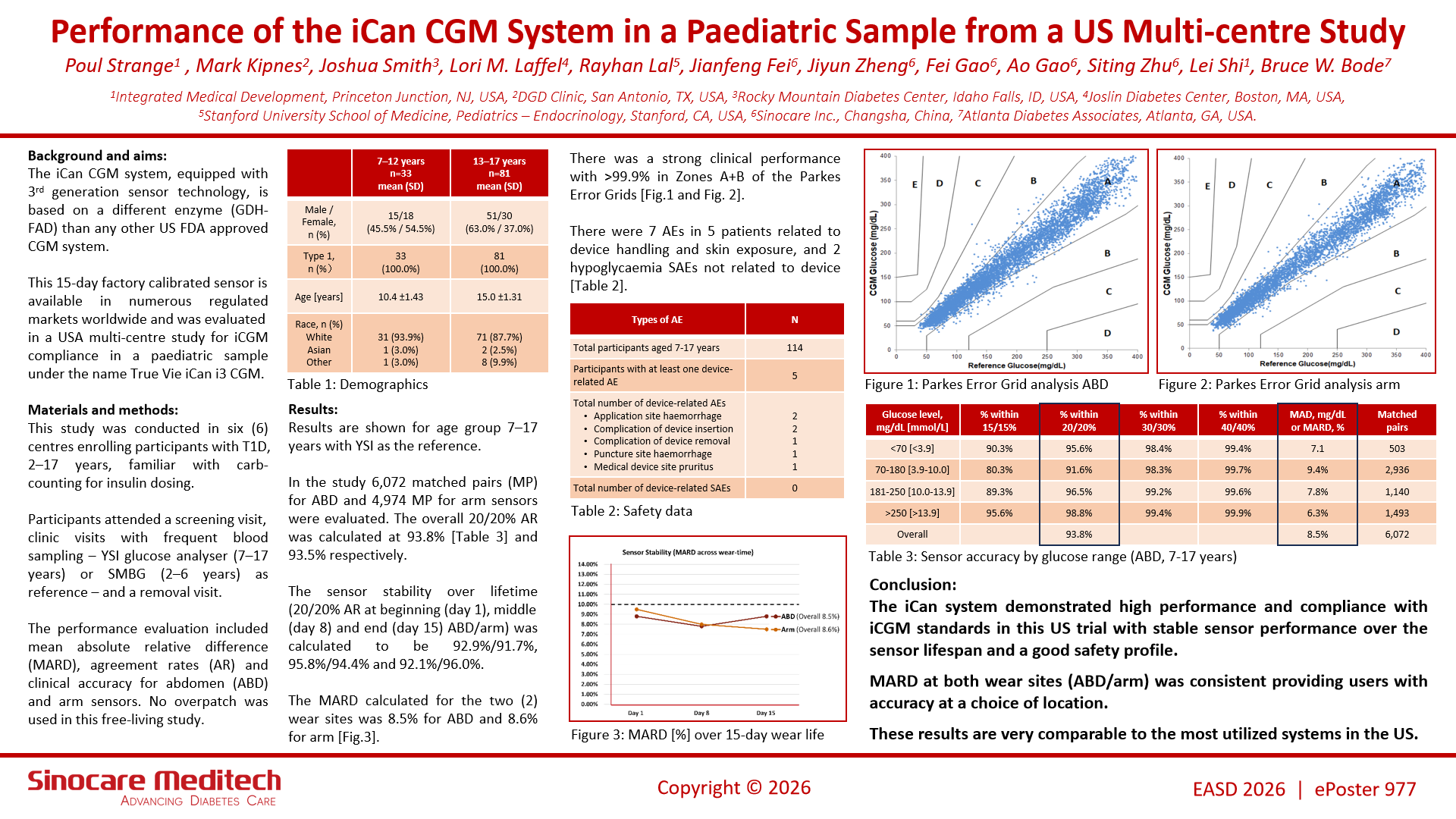
The study enrolled 129 children and adolescents with type 1 diabetes at six centers in the United States, aged 2–17; results are reported for the 114 participants aged 7–17 with a YSI reference. They wore three sensors across two wear sites and attended clinic visits at the start, middle and end of the wear period for frequent blood sampling against a YSI 2300 analyzer. No overpatch was used, and participants kept to their normal routines in this free-living study. The analysis drew on 6,072 ABD site matched pair (MP) readings and 4,974 MP readings from the Arm site. Accuracy held in the low range, where readings most directly affect safety: 95.6% of values below 70 mg/dL fell within 20/20%, with a mean absolute difference of 7.1 mg/dL.
Sensor stability was seen over device lifetime, with 20/20% Agreement Rates of 92.9% ABD and 91.7% Arm on day 1, 95.8% ABD and 94.4% Arm on day 8, and 92.1% ABD and 96.0% Arm on day 15, with a single digit MARD at both sites throughout. Seven adverse events in five participants were related to device handling and skin exposure; two serious adverse events of hypoglycemia were assessed as unrelated to the device.
Consistency of this kind is what makes a sensor workable for a child. It supports the daily decisions behind insulin dosing, overnight safety and participation in school, sport and family life, and it lets caregivers choose where to place the sensor rather than accept a single prescribed site.
The iCan CGM system uses third-generation sensor technology built on flavin adenine dinucleotide-dependent glucose dehydrogenase (GDH-FAD), an enzyme no other FDA-approved CGM system uses. The iCan 15-day, factory-calibrated sensor is available in numerous regulated markets and was evaluated in the United States as True Vie iCan i3 CGM. The pediatric data add to a clinical program spanning more than 500 participants across completed studies in the United States, Europe and Asia.
About Sinocare iCan™ CGM System
Sinocare iCan CGM System is one of the most widely clinically studied continuous glucose monitoring systems in the world.1, 2, 3, 4, 5
More than 500 people with type 1 and type 2 diabetes have participated in our world-wide clinical studies, and most clinical study participants have been assessed at sites in either the United States of America or in the Federal Republic of Germany. ~ 60.95% of 507 worldwide iCan CGM system clinical study subjects are people living with diabetes in either the USA or in Europe.
iCan CGM clinical study citations:
Enrolment n=159 https://clinicaltrials.gov/study/NCT05806554 a completed study in adults.(1)
Enrolment n=134 https://clinicaltrials.gov/study/NCT05908448 a completed study in children.(2)
Enrolment n=78 DOI: https://doi.org/10.1177/19322968261463536 a completed study in children.(3)
Enrolment n=16 https://clinicaltrials.gov/study/NCT05348928 a completed study in adults.(4)
Enrolment n=120 DOI: https://doi.org/10.3969/j.issn.1006-6187.2026.05.004 a completed study in adults.(5)
About Sinocare
Established in 2002, Sinocare is the first blood glucose meter company to be listed in China, and also the largest manufacturer of glucose monitoring devices in China. With a commercial presence in Asia, Europe and North America, Sinocare has expanded internationally through partnerships and acquisitions such as the USA based PTS Diagnostics Inc. and Trividia Health Inc., pioneering a digital management ecosystem for diabetes and chronic conditions by integrating “Biosensing + AI + Healthcare.” We provide global users and healthcare professionals with innovative products and smart medical solutions that seamlessly span prevention, monitoring, and long-term care. Today, our core portfolio comprises four strategic pillars: Personal Palm Labs, Precision Desktop Labs, Precision Wearable Systems, and Digital Diabetes Management Solutions.
Remaining steadfastly user-centric, Sinocare has built a global R&D and manufacturing infrastructure. By delivering accurate, easy-to-use, and affordable solutions, we break down the barriers of chronic disease management, bringing medical-grade diagnostics and digital health services into millions of households worldwide. By synergizing “AI Agents, Chronic Disease Expertise, and Continuous Behavioral Support,” Sinocare delivers an ecosystem of ongoing patient companionship, translating cutting-edge technology into tangible, life-changing health outcomes.