
Expert Consensus on Glycemic Variability Management Released! Leading a New Pattern of "Cardio-Glycemic Co-Management"
The comorbidity of cardiovascular diseases (CVD) and glucose metabolism disorders is severe. Nearly 80% of hospitalized patients with coronary heart disease in China have comorbid glucose metabolism disorders, and the proportion of acute coronary syndrome patients with diabetes mellitus reaches 37.6%. As an important manifestation of glucose metabolism disorders, glycemic variability is not only an independent risk factor for the prognosis of cardiovascular diseases but also accelerates disease progression.
To improve the level of glycemic variability management in CVD patients among Chinese clinicians, the Metabolic Cardiovascular Disease Group of the Committee of Cardiology, Chinese Medical Association, the Chinese Medical Association Diabetes Society, and the Editorial Board of Chinese Journal of Cardiology have organized domestic experts in cardiology and endocrinology to compile the Expert Consensus on Glycemic Variability Management in Patients with Cardiovascular Diseases (hereinafter referred to as the Consensus).
The Consensus for the first time systematically clarifies the status of Continuous Glucose Monitoring (CGM) in the glycemic management of CVD patients, providing key technical support for "cardio-glycemic co-management". This article will focus on interpreting the application value of CGM in the glycemic management of CVD patients.
Inpatient Phase: CGM Improves the Precision of Glycemic Variability Management
In hospitalized CVD patients, due to the superposition of surgery, interventional procedures, stress responses, and various therapeutic interventions, glycemic variability is more severe than in outpatients or general ward patients. Traditional glycemic monitoring methods, such as glycated hemoglobin (HbA1c) or fasting plasma glucose (FPG), can reflect long-term or static blood glucose levels but often fail to capture rapid short-term fluctuations—which are key factors affecting prognosis. The continuous monitoring feature of CGM fills this gap. The Consensus provides clear recommendations for the application of CGM in hospitalized patients:
1. Patients with Critical Cardiovascular Conditions: Routine Application of CGM is Recommended
The incidence of stress-induced hyperglycemia in critically ill cardiovascular patients ranges from 37.6% to 65%, and the incidence of hypoglycemia ranges from 3.5% to 10.1%. Both elevated and reduced blood glucose levels exacerbate glycemic variability, and this "fluctuating" state is often associated with adverse outcomes. Studies have shown that 64.7% of patients with acute heart failure have a glucose coefficient of variation (CV) >21%. For this reason, the guidelines suggest that dynamic management of glycemic variability should be emphasized in the acute critical phase of cardiovascular diseases, and blood glucose should be controlled within the range of 6~10 mmol/L.
CGM can capture short-term fluctuations such as stress-induced hyperglycemia and asymptomatic hypoglycemia in real time, avoiding the limitations of traditional single-point testing; the dynamic blood glucose data it provides can help clinicians quickly adjust hypoglycemic regimens and reduce the risk of hypoglycemia. Therefore, the Consensus clearly states: When conditions permit, CGM is recommended for all critically cardiovascular patients during hospitalization.
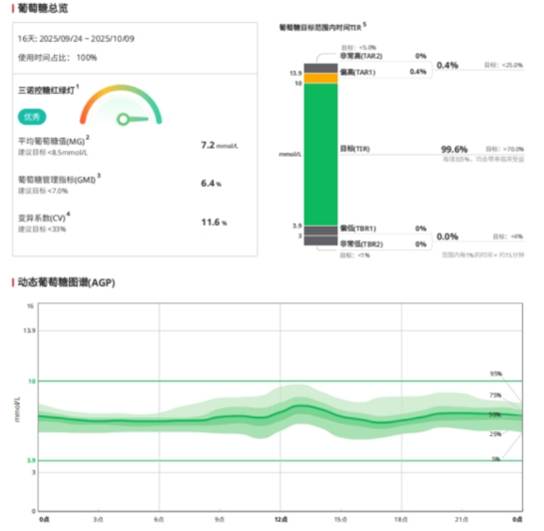
Figure. Sinocare iCan CGM Ambulatory Glucose Profile (AGP)
2. Patients with Significant Glycemic Variability: CGM is a Key Tool for Further Evaluation
Hospitalized CVD patients can determine glycemic variability initially through point-of-care glucose testing (POCT), i.e., a standard deviation of blood glucose levels ≥2 mmol/L based on POCT results indicates significant glycemic variability, and the Consensus recommends that such patients can use CGM for further evaluation. In addition, the Consensus points out: For hospitalized CVD patients without a history of diabetes who experience acute glycemic variability, regular blood glucose monitoring (including HbA1c, FPG, self-monitoring of blood glucose (SMBG), or CGM) in cardiovascular or endocrinology clinics after discharge is recommended.
CGM is recommended because it can reflect blood glucose trends dynamically and continuously, providing much richer information than single-point testing. Clinicians can understand the differences in intra-day and inter-day glycemic variability through CGM data, and identify the patterns and triggers of fluctuations, such as diet, medications, or stress responses. This not only helps adjust individualized hypoglycemic regimens but also avoids the situation where "average blood glucose seems good but variability is large", thereby improving the overall prognosis of patients.
3. Interventional and Perioperative Patients: CGM Assists in Safe Perioperative Glycemic Management
In patients undergoing cardiovascular interventional or surgical procedures, blood glucose is one of the most easily "uncontrolled" indicators. Factors such as fasting, anesthesia, and surgical stress increase the risk of glycemic variability significantly, which is closely associated with poor prognosis.
CGM can monitor perioperative blood glucose changes dynamically, guide insulin dosage adjustment, help maintain perioperative blood glucose within the safe range of 6~12 mmol/L, and reduce the risk of adverse events. The Consensus states: When conditions permit, CGM is recommended for CVD patients with significant glycemic variability undergoing interventional or surgical treatment; all patients should complete HbA1c and FPG testing before surgery, and patients suspected of undiagnosed diabetes/diabetes pre-diabetes should undergo oral glucose tolerance test (OGTT) 1~3 months after surgery for confirmation.
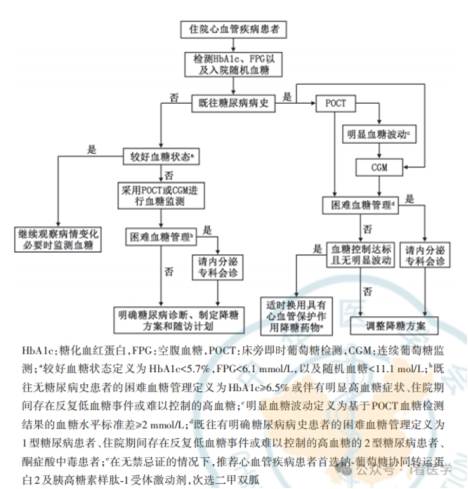
Figure. Flowchart of Blood Glucose Fluctuation Management for Cardiac Hospitalized Patients
Outpatient Follow-up: CGM Facilitates Continuous Glycemic Monitoring and Optimization
In cardiovascular clinics, most patients have chronic stable diseases such as hypertension, chronic coronary syndrome, and chronic heart failure. Although these diseases are relatively stable in clinical, numerous studies have shown that both long-term hyperglycemia and disordered glycemic variability are independent cardiovascular risk factors, which can accelerate disease progression and increase the risk of adverse cardiovascular events significantly . Based on this, the Consensus proposes a stratified CGM management strategy for outpatients:
1. Patients with Comorbid Glucose Metabolism Disorders: CGM as a Routine Monitoring Method
HbA1c reflects average blood glucose over 2~3 months and cannot reflect short-term fluctuations; SMBG is single-point testing, which is prone to missing nocturnal/asymptomatic hypoglycemia; CGM can capture intra-day/inter-day fluctuations comprehensively and evaluate the quality of glycemic control more accurately.
The Consensus recommends that outpatients with CVD and comorbid glucose metabolism disorders monitor blood glucose levels, including HbA1c, FPG, SMBG, or CGM; when conditions permit, SMBG or CGM is recommended for all outpatients with CVD whose HbA1c or FPG tests show abnormal blood glucose to identify and evaluate glycemic variability. At the same time, the Consensus further emphasizes that the appropriate monitoring method should be selected according to the patient's condition and medical conditions to achieve full-course, dynamic, and individualized glycemic management. For hospitalized CVD patients with diabetes or pre-diabetes, regular blood glucose monitoring (including HbA1c, FPG, SMBG, or CGM) in cardiovascular or endocrinology clinics after discharge is recommended.
2. Patients with Achieved Glycemic Control: CGM for Risk Reassessment
Even if glycemic control is achieved [HbA1c <7%, Time in Range (TIR) >70%], outpatients cannot afford to be careless—long-term stable monitoring is still very important! The reason is simple: some patients may have "normal" blood glucose on the surface but may actually have hidden nocturnal hypoglycemia or postprandial glycemic fluctuations.
CGM canidentify potential risks early through indicators such as Time Below Range (TBR) <4% (for young, stable patients) or TBR <1% (for elderly, multi-comorbid, unstable patients). The Consensus recommends that for outpatients with CVD and achieved glycemic control, HbA1c testing should be performed at least twice a year, and CGM may be performed if necessary to evaluate TIR and TBR.
3. Patients with Disordered Glycemic Variability: CGM Guides Regimen Optimization
CGM can analyze fluctuation patterns through AGP to guide medication adjustment, dietary intervention, and exercise planning. When conditions permit, CGM is recommended for all outpatients with CVD and significant glycemic variability; for outpatients with CVD and disordered glycemic variability, HbA1c testing is recommended every 3 months, and CGM should be performed until glycemic control is relatively stable.
CGM Becomes a Key Tool for "Cardio-Glycemic Co-Management"
Glycemic management in CVD patients needs to break through the limitation of "only focusing on average blood glucose", and CGM is the core technology to achieve "cardio-glycemic co-management":
- Accurate risk identification: CGM can early detect "occult fluctuations" such as stress-induced hyperglycemia and asymptomatic hypoglycemia, avoiding their damage to the cardiovascular system.
- Optimization of treatment regimens: Evaluate treatment effects through CGM-related indicators, guide the selection of drugs with both hypoglycemic and cardiovascular protective effects, reduce fluctuations, and improve cardiovascular prognosis.
- Long-term follow-up management: CGM data can serve as the basis for patients' self-management, and combined with regular HbA1c testing, long-term glycemic stability can be achieved.
Conclusion: Expert Consensus on Glycemic Variability Management in Patients with Cardiovascular Diseases establishes the core position of CGM in the glycemic management of CVD patients systematically for the first time . Its stratified recommendations for hospitalized (critical illness, perioperative period) and outpatient (chronic stable phase) patients provide a operable "fluctuation monitoring pathway" for clinical practice. Through CGM dynamic indicators (TIR, TBR, etc.), clinical practice can shift from "achieving average glycemic targets" to "comprehensive fluctuation control", ultimately improving the prognosis of CVD patients and promoting "cardio-glycemic co-management" from concept to practice. With the popularization of CGM technology, the collaboration between cardiovascular and endocrinology disciplines will be closer in the future, bringing greater benefits to patients.
References:
Committee of Cardiology, Chinese Medical Association; Chinese Medical Association Diabetes Society; Editorial Board of Chinese Journal of Cardiology. Expert Consensus on Glycemic Variability Management in Patients with Cardiovascular Diseases[J]. Chinese Journal of Cardiology, 2025, 53(7):757-768. DOI: 10.3760/cma.j.cn112148-20241022-00635